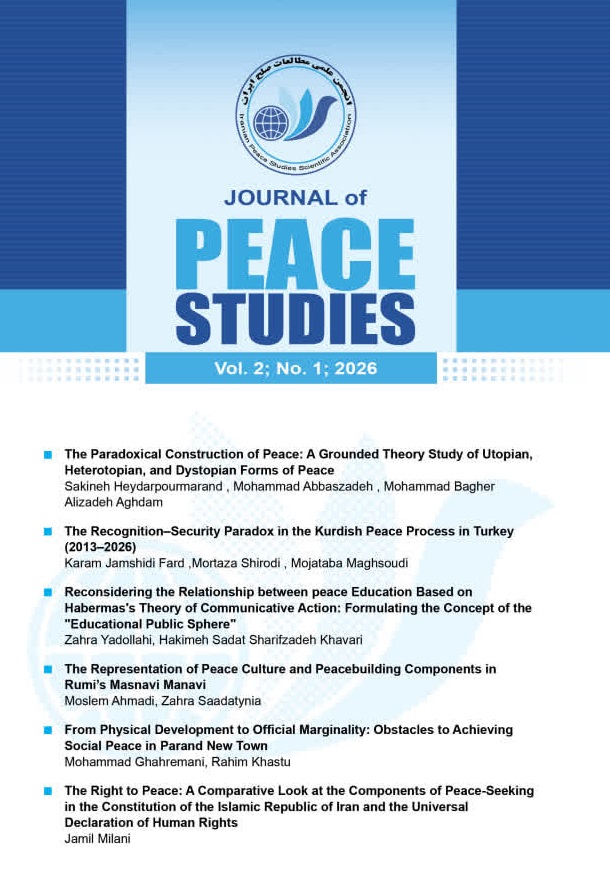
Document Type : Original Article
Authors
1
Assistant Professor, Department of Persian Language and Literature, Imam Ali University
2
Assistant Professor ,Department of Persian Language and Literature,Pa.C., Islamic Azad University, Parand, Iran.
10.22034/ipsan.2026.593922.1025
Abstract
Introduction
Peace is one of the fundamental concepts in human social and ethical thought. In contemporary peace studies, peace is no longer understood merely as the absence of war or direct violence; rather, it encompasses justice, human dignity, constructive relationships, tolerance, dialogue, and the transformation of attitudes and structures that reproduce violence. Johan Galtung’s distinction between negative and positive peace, as well as John Paul Lederach’s relational approach to peacebuilding, has contributed significantly to this broader understanding of peace. Within this theoretical framework, cultural and intellectual traditions can provide valuable resources for understanding the ethical foundations of peace. Persian mystical literature, particularly the works of Jalal al-Din Muhammad Rumi, contains extensive reflections on human relationships, self-transformation, love, tolerance, justice, and peaceful coexistence. Nevertheless, these elements have often been examined separately rather than as components of an integrated culture of peace. Therefore, the present study aims to analyze the components of peace culture in Rumi’s Masnavi, focusing on the relationship between inner transformation and social peace. The central question is how Rumi conceptualizes the transition from inner peace to peaceful human coexistence and which ethical principles constitute this process.
Methodology
This study employs a qualitative approach based on thematic content analysis of Rumi’s Masnavi. Relevant verses, narratives, and conceptual passages concerning peace, conflict, human relationships, moral transformation, love, tolerance, justice, and human dignity were identified and interpreted within the framework of contemporary peace studies. The analysis was conducted through a process of identifying meaningful textual units, coding them according to their conceptual content, grouping related codes into broader categories, and interpreting the resulting themes in relation to major concepts in peace studies. Particular attention was paid to Galtung’s concepts of positive peace, direct, structural, and cultural violence, as well as Lederach’s emphasis on relationship-building, dialogue, recognition of the other, and transformative peacebuilding. The study also draws on more recent approaches to relational and everyday peace in order to establish a conceptual dialogue between Rumi’s mystical thought and contemporary peace scholarship. The primary textual evidence was derived from Masnavi, while relevant secondary sources were used to interpret the findings and establish conceptual comparisons.
Results and Discussion
The findings indicate that peace in Rumi’s thought constitutes a continuous process beginning with individual transformation and extending toward social coexistence. The first and fundamental component is inner peace. Rumi considers self-knowledge, purification of the self, control of destructive desires, and liberation from egocentrism as prerequisites for genuine peace. In his view, anger, greed, pride, jealousy, and excessive attachment to the self-generate internal disorder and may subsequently appear as conflict and violence in human relationships. Thus, social peace cannot be achieved independently of moral and psychological transformation at the individual level.
The second component is love and empathy. In Rumi’s thought, love is not merely an emotional or mystical experience but a transformative force capable of overcoming egocentrism and strengthening solidarity with others. Love enables individuals to move beyond narrow identities and recognize deeper forms of human connectedness. In this respect, Rumi’s conception of love can be interpreted as an ethical foundation for empathy, compassion, mutual respect, and the reduction of hostility. This finding is conceptually comparable with contemporary approaches that emphasize the relational foundations of sustainable peace.
The third component is tolerance, dialogue, and acceptance of the other. Rumi repeatedly criticizes dogmatism, prejudice, and the tendency to regard one’s own perspective as the absolute measure of truth. The narratives of Moses and the Shepherd and the story of the elephant in the dark room demonstrate the limitations of partial perception and the dangers of rigid judgment. Rumi’s emphasis on listening, humility, recognition of differences, and understanding alternative perspectives provides an important ethical basis for constructive dialogue. From the perspective of peace studies, such principles correspond with relational peacebuilding, which regards recognition of the other, trust, dialogue, and transformation of relationships as essential conditions of sustainable peace.
The fourth component is justice and human dignity. Rumi explicitly defines justice in terms of placing things in their proper position and regards injustice as a deviation from balance and order. His condemnation of oppression and his emphasis on the inner value of human beings demonstrate that peace cannot be separated from ethical justice and respect for human dignity. This dimension corresponds conceptually with Galtung’s understanding of positive peace, according to which sustainable peace requires more than the absence of direct violence and depends upon just relationships and the reduction of structural and cultural forms of violence.
Finally, these components lead to peaceful coexistence and a peace-oriented society. The findings suggest that Rumi’s thought presents peace as a gradual movement from self-transformation toward interpersonal and social transformation. Accordingly, the conceptual model derived from the analysis can be expressed as follows: inner peace → love and empathy → tolerance and constructive dialogue → justice and human dignity → peaceful coexistence. This model demonstrates that Rumi does not conceptualize peace as a static condition but as a dynamic ethical process in which individual transformation creates the foundation for healthier social relationships.
Conclusion
The study concludes that Rumi’s Masnavi contains a coherent ethical framework for understanding the culture of peace. Although Rumi’s thought is rooted in Islamic mysticism rather than modern political and social theory, several of its central principles show significant conceptual affinities with contemporary peace studies. Rumi places inner transformation at the beginning of the peace process and connects it to love, empathy, tolerance, dialogue, justice, and human dignity. The distinctive contribution of this study lies in bringing these elements together as an interconnected model rather than treating them as isolated moral concepts. The findings suggest that Rumi’s thought can serve as a valuable cultural and ethical resource for dialogue between Persian mystical literature and contemporary peace studies. At the same time, the similarities identified should be understood as conceptual affinities rather than as evidence that Rumi anticipated modern peace theory. Such a cautious comparative approach allows the contemporary relevance of Rumi’s thought to be explored without separating it from its original mystical and intellectual context.
Keywords
 Journal of Peace Studies